Members of the PEPR Quantum are joining the Institut universitaire de France Class of 2026
The Institut universitaire de France (IUF) has announced the members joining the Class of 2026. They will be appointed as members effective October 1, 2026, for a term of five years. Among them are three members of the PEPR Quantum!
The mission of the Institut universitaire de France (IUF) is to promote the development of high-level research at universities and to strengthen interdisciplinary collaboration. Its members continue to carry out their work at their home universities, while benefiting from a two-thirds reduction in their teaching load and specific research grants.
Florent Baboux,
Lecturer and researcher

Florent Baboux is a faculty member and researcher at Université Paris Cité in the laboratory Matériaux et Phénomènes Quantiques (MPQ, CNRS/Université Paris Cité). His research focuses on the development of integrated photonic devices for quantum information, based in particular on the parametric generation of quantum states in nonlinear circuits.
He is participating in the NISQ2LSQ project under the PEPR Quantum on the development of frequency-encoded quantum state sources for photonic bosonic codes. He is also contributing to the QCommTestbed project on the development of polarization-entangled photon sources and their use for quantum key distribution in multi-user networks.
Within the PEPR projects
In both NISQ2LSQ and QCommTestbed, the work to which I contribute follows the same guiding principle: harnessing the various degrees of freedom of light in integrated devices to generate and control complex quantum states. My IUF project extends this approach by developing a versatile photonic platform that combines nonlinear waveguide networks and synthetic dimensions, with the goal of developing new optical functionalities that are robust against experimental imperfections and simulating quantum phenomena that are difficult to access in conventional materials.
Florent Baboux
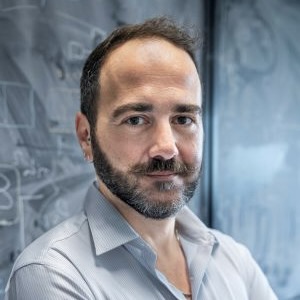
Giuseppe Di Molfetta,
University Professor
Giuseppe Di Molfetta is a professor at Aix-Marseille University and at the u Laboratoire d’Informatique et des Systèmes (LIS, Aix-Marseille University/CNRS). As director of the Quantum Initiative (QuantA) institute at Aix-Marseille, his research is internationally recognized for its pioneering use of quantum cellular automata to simulate quantum physical laws.
He is the local scientific lead for the EPIQ project under the PEPR Quantum. The project aims to develop algorithmic techniques applicable to both NISQ and fault-tolerant machines and to facilitate their practical implementation.
His project
My project aims to study how distributed architectures can improve the efficiency of quantum computing. The innovative idea is to model these architectures using networks of quantum cellular automata, equipped with local quantum memory that resembles neuromorphic models. A major innovation involves advancing the theoretical understanding of how the topology of the network and local nodes influences the efficiency of solving a computational task in a distributed manner.
Giuseppe Di Molfetta
Cristina Onete,
Lecturer and researcher

Cristina Onete is a lecturer and researcher at the University of Limoges and at the XLIM laboratory (CNRS/University of Limoges), where she is co-leader of the CRYPTIS team. Her research focuses on the construction and provable security of cryptographic protocols, particularly secure channel establishment protocols, of which TLS is an example.
She is the lead researcher for WP9: “Coordination and Integration at TLS” of the PEPR’s PQ-TLS project and is also participating in WP6 (Security Proofs).
Within PQ-TLS
Within PQ-TLS, my role essentially consists of three different tasks:
- Developing a demonstrator that enables us to envision a transition from classical cryptography to solutions offering post-quantum security, by evaluating the various technical alternatives, their advantages, and their disadvantages.
- Building on the results obtained in other project work packages (primitives, resistance to side-channel attacks) to develop solutions that can enhance the security of TLS in everyday use.
- Contributing to security analyses of the proposed protocols.
Cristina Onete
Latest news
No news
More news Awards