
Call for proposals: Supporting a new generation
As part of the PEPR Quantum governance project, its lead institutions—CNRS, CEA, and Inria—launched a call for proposals in 2026: Supporting a new generation. This call is now closed.
Aims of the Call
- Support efforts to structure and renew scientific communities in direct connection with the projects of the PEPR Quantum.
- Enable young researchers to launch new initiatives in conjunction with the PEPR Quantique projects.
- Strengthen the foundation of these early-career scientists so they can lead high-level teams, thereby contributing to the commitments of the lead institutions of the PEPR Quantum to scientific excellence.
Key elements
The proposed projects will have a maximum duration of three years. The requested funding will cover a maximum budget of €500,000, including administrative costs for the lead institution.
The selected young researcher may propose, within the limits of the allocated budget, a budget that includes the following types of expenses, in accordance with the financial regulations of the Quantum PEPR:
- Operating costs
- Costs for non-permanent staff
- Equipment costs
Calendar
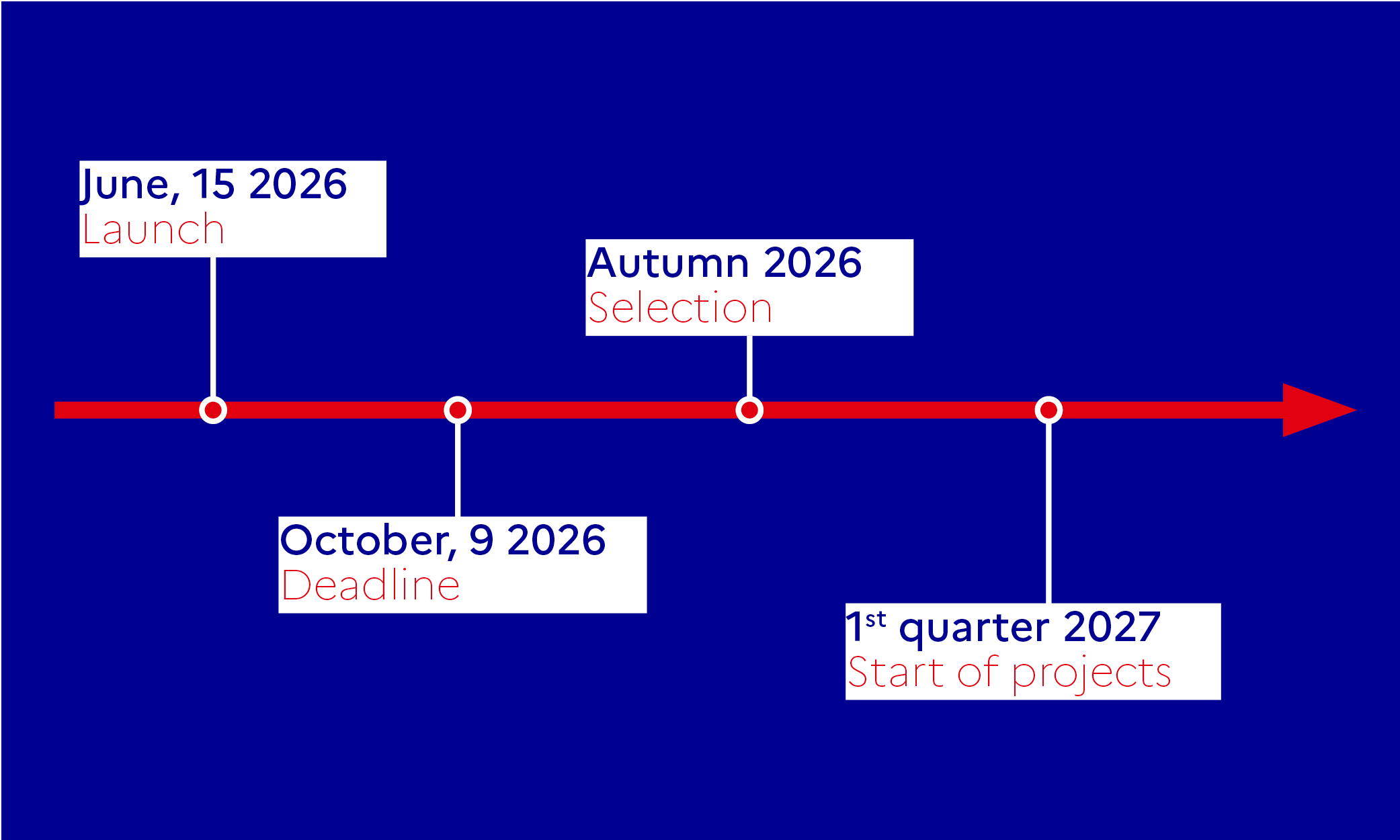
Candidate Profile
This call for proposals is open to early-career researchers, regardless of nationality, who obtained a permanent position less than 5 years prior to the closing date of this call, i.e., after October 9, 2021. In the case of parental leave, a 18-month extension per child is permitted.
The program is open to any researcher or research professor affiliated with a French public research institution, regardless of their specific organization.
Recipients of funding such as an “ERC Starting Grant” or “ANR JCJC” are required to mention this in their project proposal. They must specify the scope of the project and how it relates to this application.
Recipients of this Call for Proposals may apply to similar programs, but may not combine funding from those programs with that of the Call.
Submission Guidelines
The application file must include all the information necessary for the scientific and technical evaluation of the project. It must be submitted before the deadline for the call for proposals.
The complete application file consists of:
- A “scientific document,” no longer than 15 pages, written in French or English, including a description of the proposed project, following the provided format
- A complete list of the scientific publications by the principal investigator proposing the project
- A resume (in French or English)
- A letter of support from the host laboratory
Must the candidate already hold a permanent position?
Yes, this is a requirement. You must have held a permanent position (researcher, associate professor, etc.) for less than 5 years prior to the application deadline (i.e., after October 9, 2021). An extension of 18 months per child on parental leave is permitted.
Can I apply if I don’t have any experience in quantum technologies?
Yes, it is strongly encouraged if you can demonstrate credible potential. In your scientific proposal, you must demonstrate the specific thematic connection between your field of study and at least one targeted PEPR project.
Your application will be evaluated based on:
- the relevance and depth of your subject-matter expertise;
- indicators of interdisciplinary work (co-publications, cross-disciplinary collaborations);
- the clarity and credibility of the research concept in the field of quantum physics.
The involvement of a partner team with strong expertise in quantum technologies is an asset. A track record demonstrating this interdisciplinary approach is viewed as a strategic risk-taking initiative aligned with the objectives of the PEPR.
Does having an ongoing ERC or ANR JCJC project make my application ineligible?
No, but you must be transparent. You must disclose any current funding (ERC Starting Grant, ANR JCJC) and clarify how it relates to your AMI Nouvelle Génération project.
Important: If you are awarded both an ERC/ANR grant and the PEPR grant, you will have to choose between the two. We do not fund the same project twice.
I am presently supported by an ANR JCJC research grant. I have an idea for a research project which is entirely distinct from my ANR JCJC project, and I wish to apply to the PEPR-Q with this project. Is this possible?
Yes, you are eligible to apply, however you are required to state this explicitly in your proposal. You will need to highlight 1) how this project relates to your activities within the PEPR and your current project, and 2) what additional thematic contributions it makes for the coming years within your discipline (or even in others, depending on what you are proposing). The selection committee will value the proposal’s independence from your current projects.
Doesn’t this conflict with the ANR JCJC/ERC StG grants (I did see the note on the PEPR website)?
There is no incompatibility in principle. You may apply to the ‘Nouvelle Génération’ call even if you currently hold an ERC StG or ANR JCJC grant, but you must be transparent about this. You must disclose any ongoing funding (ERC Starting Grant, ANR JCJC) and clarify how this relates to your proposal for the AMI Nouvelle Génération. Important: if you are awarded both an ERC/ANR grant and the AMI Nouvelle Génération, you will have to choose between the two funding streams. We do not fund the same topic twice.
Does obtaining the “New Generation” AMI prevent me from applying for an ERC Starting Grant?
The aim of the “New Generation” AMI is to act as a stepping stone to the ERC, not to replace it. If you are awarded a project under the New Generation AMI, you will have demonstrated that you have already led a major project, which will be an added value for an ERC proposal.
As a tenure-track lecturer, I would like to know whether I meet the eligibility criteria, which specify ‘permanent’ positions.
You are eligible.
I am taking up a permanent position as a Research Engineer. Is this call open to someone with my profile?
You are eligible. You will need to clearly explain the independent scientific component of your research project and your ability to lead a project team (we recommend that you include a dedicated section addressing this).
Is there an age limit?
No, there is not.
What is the exact duration of the project?
Mandatory start date: first quarter of 2027. Mandatory end date: December 31, 2029.
No extension is planned beyond this date, except in exceptional cases. The actual duration therefore depends on your exact start date (approximately 2 to 2.5 years).
A PEPR project ends in late 2029; can I continue my work after that?
Your project may explore themes that the PEPR project has initiated and that require further development. However, your funding will end on December 31, 2029. You will need to consider other sources of funding after that date (for example, European funding; see the question below).
What does “complementarity” with PEPR projects mean?
Your project must establish a structured thematic link with at least one targeted PEPR project. This means:
- Create a new branch: explore a different angle, variation, or application of the PEPR project’s main research area, or
- Expand on a conceptual element: further develop or sustain a scientific focus explored by the PEPR project.
Tip: Clearly describe in your scientific proposal how your project expands or extends the scope of the PEPR project. Coordinate with the project coordinator in advance to confirm this complementarity.
As the principal investigator on an ANR JCJC project, I have two potential PEPR projects I could get involved in: one is more closely related to and complementary of my ANR JCJC project, whilst the other is more distant, though still within my field of interest and expertise. Will the fact that I am joining a more distant project be viewed negatively? Or will my potential to explore new topics and broaden my horizons be valued?
The choice is yours. Please note that it is the overall scientific quality of your proposal that will be the deciding factor and will be assessed. You can therefore choose between these two options based on this criterion.
I am well aware of the intended scope of the initiative, which is limited to PEPR projects, however, I would appreciate clarification: is it possible to submit a proposal in conjunction with other initiatives supported by the SNQ?
The priority is to support and complement the thematic scope of the PEPR. This criterion is essential for a proposal to be eligible. Nevertheless, interaction with other SNQ programmes is welcomed. There are PEPR projects, such as those arising from ANR calls, with which your proposal could undoubtedly be linked.
What exactly does “€500,000 including a 20% administrative costs” mean?
This means: €500,000 total = direct costs + 20% of those costs. Therefore, the maximum direct costs are €416,000, and your institution’s administrative expenses will amount to €84,000.
Formula: direct costs = €500,000 ÷ 1.20 = maximum €416,670.
Can I provide funding for doctoral students in my project?
Doctoral students are eligible; we will evaluate the viability of your proposal as a whole (consistency between the budget, objectives, and project duration).
Is co-funding optional or required?
Optional. An excellent project without co-funding will not be penalized.
However, if you identify a relevant source of co-funding for your project (local government, industry, another national program), this is an asset, provided that this resource is truly aligned with your objectives and does not impose constraints that are incompatible with the PEPR.
Should I make use of existing infrastructure?
No, it is not mandatory. However, if you have access to PEPR or EquipEx+ facilities (such as aQCess or e-DIAMANT) or other national infrastructure (such as RENATECH), please indicate this in your application. This is valuable information: it demonstrates your project’s strong ties to the quantum ecosystem and its ability to create synergies.
What does the “30% PEPR contribution” threshold mean?
There are two distinct rules:
- For you (the project leader): You cannot already be committed to more than 30% of an existing PEPR project.
- For your partners: if one of them is already involved in a PEPR project, they must be able to demonstrate that at least 30% of their staff’s time is dedicated to your new project, with no overlap in subject matter.
This rule ensures that everyone makes a genuine new contribution, without duplication.
What are your expectations regarding Open Science?
Once your project has been selected and launched, you will need to outline the Open Science elements applicable to your project (HAL, CC-BY, FAIR, preprints, etc.) in a data management plan.
For the initial application, simply describe how you plan to make your results accessible and compliant with the FAIR principles.
Can I combine this funding with an ERC grant I have already received?
See the question “Does having an ongoing ERC or ANR JCJC…” above. In short: transparency is mandatory, and you will have to choose between the two if you are awarded both.
What happens after the project ends (December 31, 2029)?
Funding will end on this date. The call for proposals is designed to support you in developing a sufficiently structured research plan and team to qualify for European funding (ERC, EIC, collaborative projects) or other national sources after 2030. This is the “springboard” objective of this AMI.
If you have any questions, please contact the PEPR Quantum management team: direction[@]pepr-quantique.fr
We strongly recommend that you contact the coordinators of the targeted PEPR projects before submitting your application to ensure a good fit.